

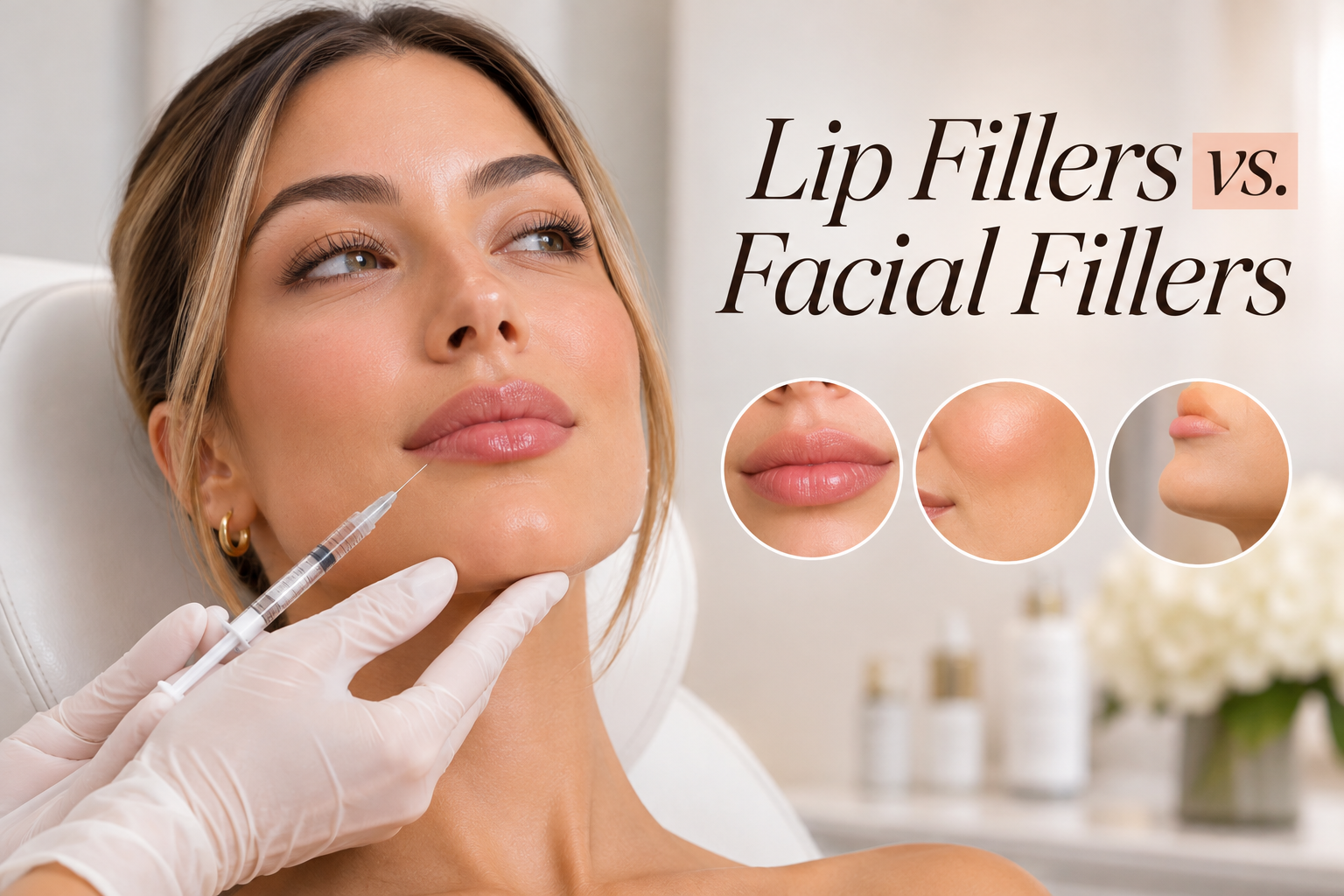
If you are considering cosmetic injectables, you may have come across two popular treatment options: lip fillers and facial fillers. Both can enhance certain facial features, but they are not necessarily used for the same reasons.
Understanding lip fillers vs facial fillers is an important first step toward choosing a treatment that aligns with your aesthetic goals, facial anatomy, and medical needs.
Some people want to add subtle volume to their lips, while others are interested in restoring fullness to their cheeks, improving facial contours, or addressing certain lines associated with aging.
Although both treatments fall under the broader category of dermal fillers, their placement, intended effects, and treatment considerations can differ.
At Effortless Touch Miami, we believe that learning about your options before scheduling an aesthetic procedure helps you make informed decisions.
This guide explores how lip fillers and facial fillers work, their potential benefits, expected recovery, longevity, possible complications, and what to discuss during a professional consultation.
What Are Dermal Fillers?
Dermal fillers are injectable substances used to add volume, improve certain facial contours, and address specific aesthetic concerns.
The U.S. Food and Drug Administration (FDA) has approved various dermal filler products for particular indications, including augmentation of the lips, cheeks, and chin, and correction of certain facial wrinkles and folds.
Not every filler is approved for every treatment area.
A qualified medical professional must select an appropriate product based on its approved uses, your anatomy, and your medical history.
How Do Dermal Fillers Work?
Unlike Botox, which temporarily reduces targeted muscle activity, dermal fillers are placed beneath the skin or within certain tissues to create volume or improve contour.
Their effects depend on the material used.
Some fillers provide an immediate volumizing effect. Others are designed to stimulate collagen production over time.
The amount of product, placement technique, and treatment area all influence the final appearance.
What Are Hyaluronic Acid Fillers?
Hyaluronic acid, often abbreviated as HA, is a substance naturally found in the body.
Hyaluronic acid-based dermal fillers are widely used for cosmetic treatments because they can provide volume and are available in formulations designed for different anatomical areas.
HA fillers vary in firmness, flexibility, and other physical properties.
A product appropriate for one part of the face may not be suitable for another.
Although certain HA fillers can be broken down using an enzyme called hyaluronidase, removal is a medical procedure with its own risks. It may not fully reverse every complication or restore the exact pre-treatment appearance.
This is why product selection and professional administration matter.
What Are Lip Fillers?
Lip fillers are dermal fillers specifically used to change the appearance of the lips.
They may be considered by adults who want additional fullness, improved definition, or correction of certain volume-related asymmetries.
Most commonly, lip augmentation is performed with an appropriately selected hyaluronic acid filler.
The goal should be based on your natural anatomy and personal preferences rather than a single ideal lip shape.
Common Reasons People Choose Lip Fillers
Patients may consider lip fillers for several reasons.
Adding lip volume: Some people naturally have thinner lips and would like a fuller appearance.
Enhancing lip definition: Fillers may help define portions of the lip border in appropriately selected patients.
Addressing volume-related asymmetry: When one side of the lips appears less full than the other, carefully planned filler placement may improve the balance.
Restoring age-related fullness: Lip volume and surrounding tissues can change over time. Fillers may address some of these changes.
Refining overall proportions: A clinician may assess how the upper and lower lips relate to the rest of the face.
Not every concern can or should be corrected with filler. Significant asymmetry, functional problems, or underlying medical conditions may require a different evaluation.
Can Lip Fillers Look Natural?
Natural-looking lip filler results are possible, but they cannot be guaranteed.
The appearance depends on the amount and type of product, lip anatomy, injection technique, and the patient’s goals.
A conservative treatment plan may be preferable when someone wants a subtle enhancement.
Excessive filler or inappropriate placement can produce an overfilled appearance or unwanted changes in lip shape.
Your consultation should include a discussion of what is realistic for your facial proportions.
What Are Facial Fillers?
Facial fillers are a broader category of injectable treatments used in different areas of the face.
They may be used to address volume loss, improve certain contours, or reduce the appearance of particular folds and wrinkles.
Because the face contains complex blood vessels, nerves, and anatomical structures, treatment planning requires detailed knowledge of facial anatomy.
Common Facial Filler Treatment Areas
Depending on the product’s FDA-approved indications, facial fillers may be used in areas such as:
- Cheeks
- Chin
- Nasolabial folds
- Certain lines around the mouth
- Other approved facial contouring areas
The appropriate treatment area depends on the specific product and the patient’s anatomy.
Not all facial injection sites have the same risk profile.
The FDA recommends against dermal filler injections in certain locations, including the nose, forehead, area between the eyebrows, and around the eyes, because these are not FDA-approved uses and can involve serious complications.
Cheek Fillers
Cheek fillers may be used to add fullness or improve the appearance of certain midface contours.
Some patients seek cheek enhancement because they have naturally less prominent cheeks.
Others are concerned about age-related volume changes.
A provider should evaluate facial structure and determine whether filler is appropriate.
Chin Fillers
Certain fillers are approved for chin augmentation in adults.
The treatment may help improve chin projection or contour in appropriately selected patients.
However, facial balance depends on multiple structures, and filler is not a substitute for correcting significant skeletal or functional concerns.
Fillers for Facial Folds
Some dermal fillers are approved to improve the appearance of moderate to severe facial wrinkles or folds.
Nasolabial folds, which extend from the sides of the nose toward the corners of the mouth, are one example.
Treatment suitability depends on the cause of the fold and the individual’s anatomy.
Lip Fillers vs Facial Fillers: What Is the Difference?
The main difference between lip fillers and facial fillers is the intended treatment area and aesthetic objective.
Lip fillers focus specifically on the lips.
Facial fillers may be used in several other approved areas to address contour, volume, or certain wrinkles.
| Feature | Lip Fillers | Facial Fillers |
|---|---|---|
| Primary goal | Lip volume and definition | Facial volume, contour, or fold correction |
| Common areas | Upper and lower lips | Cheeks, chin, and approved facial folds |
| Product selection | Formulations suited to lip tissue | Varies by facial area and indication |
| Results | Often visible soon after treatment | Often visible soon after treatment, depending on product |
| Recovery | Temporary swelling and bruising possible | Temporary swelling and bruising possible |
| Duration | Depends on product and individual factors | Depends on product, area, and individual factors |
| Risks | Injection-related and vascular complications | Injection-related and vascular complications |
Importantly, lip fillers are a type of facial dermal filler. The comparison is between lip-specific augmentation and other facial filler applications, not two entirely separate classes of medication.
Benefits of Lip Fillers
Lip fillers may offer several cosmetic benefits when performed appropriately.
1. Increased Lip Fullness
Hyaluronic acid fillers can add volume to the lips.
The degree of enhancement depends on the treatment plan and individual anatomy.
2. Improved Lip Definition
Some patients want to enhance the outline or shape of their lips rather than significantly increase their size.
A clinician can discuss whether filler is suitable for that goal.
3. Temporary Results
Most commonly used lip fillers are temporary.
This means the appearance gradually changes as the product is broken down or otherwise changes over time.
However, temporary does not mean that all effects or complications are immediately reversible.
4. Individualized Treatment
The amount and placement of filler can be tailored to the patient’s anatomy and preferences.
A personalized plan is particularly important for patients seeking subtle results.
Benefits of Facial Fillers
Facial fillers can address a different range of cosmetic concerns.
1. Restoring Certain Types of Facial Volume
Volume changes can occur with age, genetics, and other factors.
Fillers may improve the appearance of selected areas where volume is reduced.
2. Enhancing Facial Contours
Appropriately selected fillers can alter the appearance of cheek or chin contours.
The objective should be discussed during a consultation rather than assumed from a photograph or social media trend.
3. Softening Certain Facial Folds
Some filler products are approved for treating specific facial folds and wrinkles.
Their effectiveness depends on the cause and severity of the concern.
4. Nonsurgical Treatment Options
Many filler procedures can be performed during an office visit without surgery.
However, they remain medical procedures and can involve serious complications.
How Long Do Lip Fillers Last?
The duration of lip fillers depends on the specific product, treatment technique, and individual response.
The American Academy of Dermatology notes that hyaluronic acid gel fillers generally last approximately four to twelve months, although results vary.
Some products and treatment areas may have different expected durations.
Lip movement, product characteristics, and individual biological factors may influence how long the enhancement remains noticeable.
You should ask your provider about the expected duration of the exact product recommended for your lips.
Do Lip Fillers Completely Disappear?
Hyaluronic acid fillers are designed to be gradually broken down, but the timing can vary.
Visible volume reduction does not necessarily mean every trace of product has disappeared.
Some filler may persist longer than expected.
If you are unhappy with your appearance, do not assume that adding more product is the best solution.
A qualified clinician can evaluate the area and discuss appropriate options.
How Long Do Facial Fillers Last?
Facial filler longevity varies significantly by material and treatment location.
According to the American Academy of Dermatology, approximate durations include:
- Hyaluronic acid gel: often four to twelve months
- Calcium hydroxylapatite: approximately six months to one year
- Poly-L-lactic acid: approximately one to three years
- PMMA fillers: considered permanent
These are general ranges, not guarantees.
Different products have different indications, and some are unsuitable for certain facial areas.
Longer-lasting results do not automatically make a filler safer or better.
Permanent and semi-permanent products may be particularly difficult to remove if complications develop.
What Happens During a Dermal Filler Appointment?
Whether you are considering lip fillers or facial fillers, the process should begin with a medical consultation.
Step 1: Consultation and Medical History
Your provider should ask about your health, medications, allergies, prior injections, and treatment expectations.
It is important to disclose:
- Previous dermal filler treatments
- The type and location of previous filler, if known
- Allergies and prior reactions
- Active skin infections
- History of cold sores, especially for lip treatment
- Pregnancy or breastfeeding
- Bleeding disorders or medications affecting bleeding
- Autoimmune or inflammatory conditions
- Recent dental procedures or infections
- Upcoming medical or cosmetic procedures
Some of these factors may require postponement, additional precautions, or a different treatment plan.
Step 2: Facial Assessment
Your clinician will evaluate facial anatomy and discuss your goals.
For lip treatment, this may include examining lip shape, symmetry, and surrounding tissue.
For other facial fillers, the assessment may focus on contour, volume distribution, and structural relationships.
Step 3: Product Selection
Different fillers have different physical characteristics and approved uses.
Your provider should explain which product is recommended, why it is appropriate, and what risks are associated with it.
Ask to see the product name and review its patient information.
Step 4: Injection Procedure
Depending on the treatment, the clinician may use a needle or cannula to place filler.
Comfort measures may include topical anesthetic, local anesthetic, or other methods.
The American Academy of Dermatology reports that many filler procedures take approximately 15 to 30 minutes, although consultation and treatment complexity can extend the appointment.
Step 5: Aftercare and Follow-Up
You should receive instructions covering expected swelling, activity restrictions, signs of complications, and when to contact your provider.
A follow-up assessment may be recommended depending on the product and treatment area.
Is There Downtime After Lip or Facial Fillers?
Many patients can resume ordinary daily activities shortly after a filler appointment.
However, temporary swelling, tenderness, redness, or bruising can occur.
Lip swelling may be especially noticeable because the area is sensitive and highly vascular.
Initial appearance should not be mistaken for the final result.
What to Expect During Recovery
Immediately after treatment: You may notice swelling, redness, tenderness, or visible volume changes.
First several days: Swelling or bruising may become more noticeable before improving.
One to two weeks: Many common temporary reactions improve during this period, although recovery varies.
After swelling settles: The treatment’s appearance can be assessed more accurately.
Persistent pain, increasing swelling, unusual discoloration, or other concerning symptoms require medical evaluation.
Dermal Filler Aftercare Tips
Your injector’s personalized instructions should take priority.
General aftercare recommendations may include:
Avoid Excessive Pressure
Do not massage or press the treated area unless your provider specifically instructs you to do so.
Different filler materials have different aftercare requirements.
Temporarily Avoid Strenuous Exercise
The American Academy of Dermatology advises waiting until the following day before strenuous exercise after many filler procedures.
Your clinician may recommend a different interval based on the treatment.
Minimize Unnecessary Heat and Sun Exposure
Follow instructions about sun exposure, tanning, and activities that could aggravate swelling.
Use Cold Compresses Only as Directed
A clinician may recommend gentle cooling for temporary swelling.
Avoid applying excessive pressure or placing ice directly on the skin.
Monitor for Complications
Know which symptoms are expected and which require urgent attention.
You can review additional information on the Effortless Touch Aftercare Instructions page.
If that page is updated to a new URL, the internal link should be updated accordingly.
Are Lip Fillers and Facial Fillers Safe?
FDA-approved dermal fillers have established indications and known risk profiles, but no injectable filler is completely risk-free.
Safety depends on appropriate product selection, the treatment location, individual medical factors, and the injector’s qualifications.
Common Side Effects
Possible temporary reactions include:
- Swelling
- Bruising
- Redness
- Tenderness
- Pain
- Itching
Many mild reactions improve within days to weeks.
Less Common Complications
Other possible problems include:
- Infection
- Allergic reactions
- Persistent swelling
- Nodules or lumps
- Filler migration
- Delayed inflammatory reactions
- Unwanted contour changes
Some complications can occur weeks or months after treatment.
Serious Complications: Vascular Occlusion
One of the most serious risks is accidental injection of filler into a blood vessel.
This can obstruct blood flow and cause tissue damage.
In rare cases, filler-related vascular complications can result in skin necrosis, visual impairment or blindness, or stroke.
Seek emergency medical care immediately if you experience sudden vision changes, severe or unusual pain, white, gray, or blue skin discoloration, or symptoms of a stroke during or after filler treatment.
These are medical emergencies, not routine recovery symptoms.
The FDA specifically warns patients about these risks.
For this reason, fillers should only be administered by appropriately licensed, trained healthcare professionals who understand facial vascular anatomy and have an emergency response plan.
Can Dermal Fillers Be Dissolved?
Some hyaluronic acid fillers can be reduced or dissolved with hyaluronidase.
However, this does not mean filler treatment is risk-free or fully reversible.
Hyaluronidase has its own risks and may not correct every adverse effect.
Certain non-HA fillers cannot be dissolved using this enzyme.
In some situations, removing filler may require other medical interventions, and complete removal may not be possible.
If you are considering filler because someone has described it as easily reversible, ask for a more complete explanation before proceeding.
Lip Fillers vs Botox: Are They the Same?
Lip fillers and Botox are different types of injectable treatments.
Botox temporarily reduces selected muscle contractions.
Dermal fillers add volume or alter tissue contours.
For example, someone seeking fuller lips may be considering a filler, while someone concerned about forehead expression lines may be evaluating Botox.
Some clinicians also discuss a procedure commonly called a “lip flip,” which uses botulinum toxin rather than filler.
A lip flip does not add physical volume in the same way as dermal filler, and it has its own risks and limitations.
These treatments should not be considered interchangeable.
For more information about botulinum toxin, explore our article Botox for Beginners: Benefits, Results, Side Effects, and What to Expect.
Editorial note: Add the direct link to the Botox article once its final WordPress URL is confirmed.
How to Choose Between Lip Fillers and Facial Fillers
The appropriate choice depends on what you want to change.
Consider Lip Fillers If Your Main Concern Is Lip Volume
If your primary goal is additional lip fullness or definition, lip-specific filler treatment may be worth discussing.
However, the provider must determine whether your anatomy and medical history make you a suitable candidate.
Consider Facial Fillers for Certain Volume or Contour Concerns
If you are concerned about cheek volume, chin contour, or particular facial folds, a facial filler consultation may be appropriate.
A clinician can assess whether filler, another treatment, or no procedure is the best option.
Consider Your Overall Facial Balance
Treating one feature can affect the appearance of the entire face.
A balanced treatment plan should consider your natural proportions rather than focusing only on an isolated area.
Understand Your Budget and Maintenance Expectations
Because most fillers are temporary, maintenance may involve additional appointments and costs.
Ask about product pricing, the amount recommended, expected duration, and potential follow-up expenses.
Avoid choosing an injectable treatment solely because it is discounted.
Prioritize Medical Safety
A qualified provider should discuss contraindications, expected results, complications, and alternatives.
You should never feel pressured to receive filler during your first consultation.
How to Choose a Dermal Filler Provider in Miami
If you are researching lip fillers or facial fillers in Miami, choosing a properly qualified medical professional is essential.
Ask the following questions before scheduling treatment:
- Who will perform the injections?
- What medical license and training do they have?
- Which filler product will be used?
- Is the product FDA-approved for the intended use?
- What complications are possible in this treatment area?
- How are vascular emergencies recognized and managed?
- What results are realistic for my anatomy?
- How long might the product last?
- What follow-up care is available?
- What is the total cost?
A trustworthy consultation should provide clear answers and allow you to make an informed decision.
You can learn more about Effortless Touch Miami and explore the clinic’s aesthetic and wellness services.
Frequently Asked Questions About Lip Fillers vs Facial Fillers
Are lip fillers different from facial fillers?
Lip fillers are a type of dermal filler used specifically for lip enhancement. Facial fillers is a broader term that includes fillers used in other approved areas, such as the cheeks, chin, and certain facial folds.
Which lasts longer, lip fillers or facial fillers?
Longevity depends on the product, treatment area, and individual response. Some facial filler products last longer than commonly used lip fillers, but there is no universal rule.
Do lip fillers hurt more than cheek fillers?
Discomfort varies by person and treatment area. The lips can be sensitive, so providers may use anesthetic techniques to improve comfort.
How long does lip filler swelling last?
Temporary swelling often improves over several days, but it can take longer for the appearance to settle. Contact your provider if swelling worsens, persists, or is accompanied by concerning symptoms.
Can lip fillers and facial fillers be done during the same appointment?
In some cases, a qualified clinician may plan treatment in multiple areas during one appointment. Suitability depends on your medical history, anatomy, the products used, and the overall treatment plan.
Are hyaluronic acid fillers permanent?
No. Hyaluronic acid fillers are generally considered temporary, although product persistence varies and may be longer than the visible cosmetic effect.
Can fillers migrate?
Filler migration has been reported. Its likelihood and management depend on several factors, including product characteristics, placement, anatomy, and treatment history.
What happens if filler enters a blood vessel?
Accidental intravascular injection can interrupt blood supply and cause serious complications, including tissue necrosis, blindness, or stroke. Sudden vision changes, severe pain, abnormal skin discoloration, or neurological symptoms require emergency medical attention.
Should I get Botox or dermal fillers first?
There is no universal order. Botox and fillers address different concerns. A professional consultation can help determine whether either treatment is appropriate for your goals.
Final Thoughts: Which Treatment Is Right for You?
When comparing lip fillers vs facial fillers, the most important distinction is what each treatment is intended to accomplish.
Lip fillers primarily focus on lip volume and definition.
Other facial fillers may address selected contour concerns, volume changes, or certain facial folds.
Both approaches require individualized planning, realistic expectations, and a clear understanding of potential complications.
Rather than choosing a treatment based on trends or photographs, consider discussing your goals with a qualified healthcare professional who can evaluate your anatomy and explain your options.
Explore Dermal Filler Treatments at Effortless Touch Miami
Interested in learning more about lip enhancement, facial fillers, or other aesthetic treatments?
At Effortless Touch Miami, you can explore available services and request a consultation to discuss your aesthetic goals.
Your treatment decisions should always be based on professional guidance, appropriate medical care, and your individual needs.
Medical References
- U.S. Food and Drug Administration — Dermal Fillers (Soft Tissue Fillers)
- FDA — Dermal Filler Do’s and Don’ts for Wrinkles, Lips and More
- American Academy of Dermatology — Fillers: FAQs
- The Aesthetic Society — Dermal Fillers Recovery & Aftercare
Medical disclaimer: This article is intended for general educational purposes only and does not replace professional medical advice, diagnosis, or treatment. Dermal fillers are medical procedures with potential risks. Consult an appropriately licensed healthcare professional before undergoing any injectable treatment.