

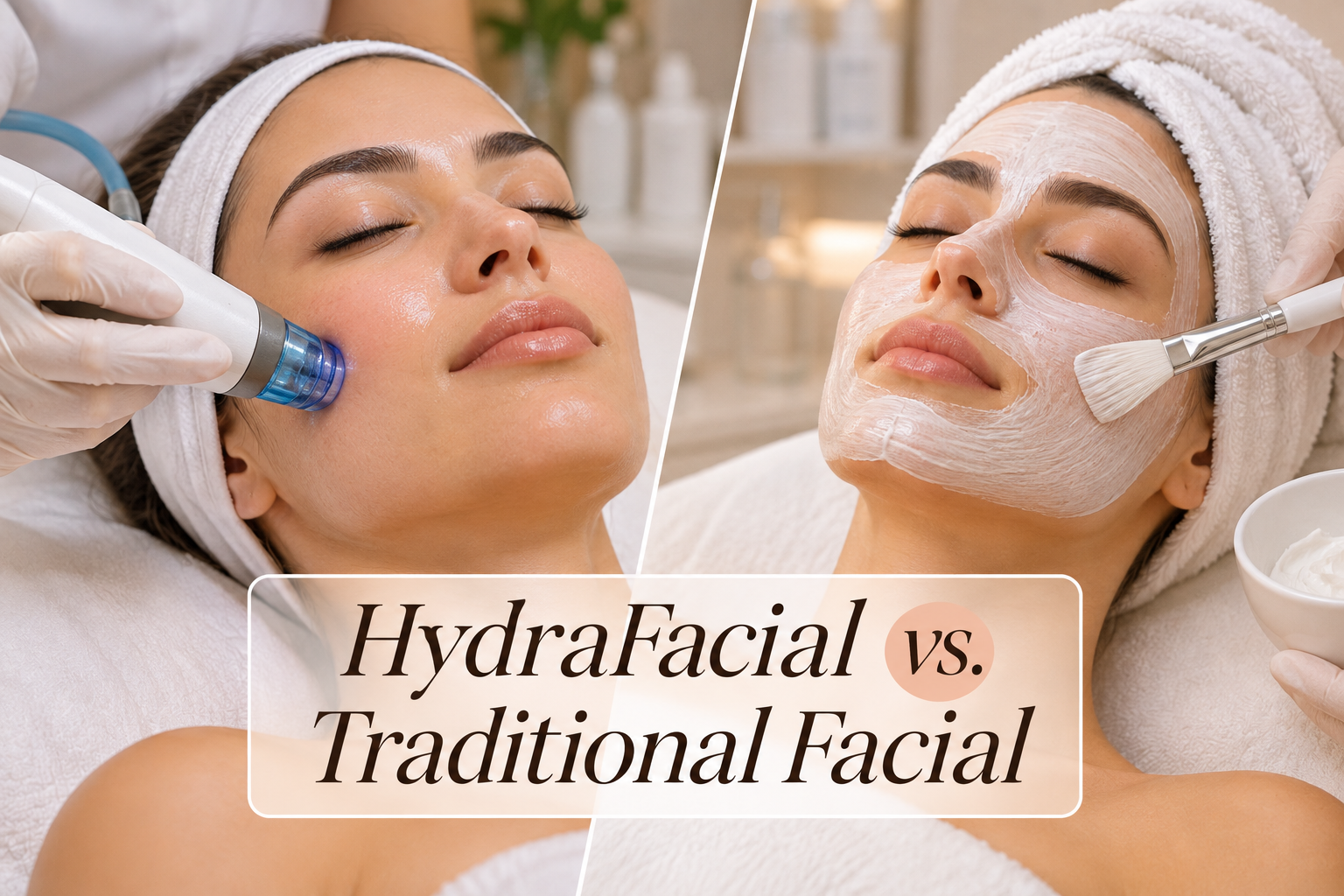
Choosing the right facial treatment can feel overwhelming, especially when different services promise smoother, brighter, and healthier-looking skin.
Two popular options are HydraFacial and traditional facial treatments. Both are designed to improve the appearance and condition of your skin, but they use different techniques and may be better suited to different concerns.
When comparing HydraFacial vs traditional facial, the most important question is not simply which treatment is more advanced. It is which approach is appropriate for your skin type, current skin condition, and personal goals.
A person experiencing dryness and clogged pores may benefit from a different facial than someone with highly sensitive skin or an active inflammatory skin condition.
At Effortless Touch Miami, we believe that understanding your options is an essential part of making informed skincare decisions.
In this guide, we explain how both facial treatments work, their potential benefits, key differences, recovery expectations, costs, and the factors to consider before scheduling an appointment.
What Is a HydraFacial?
HydraFacial is a branded, noninvasive facial treatment that uses specialized equipment to cleanse, exfoliate, extract impurities, and deliver hydrating skincare solutions.
Unlike many traditional facials, which rely primarily on manual techniques and separately applied products, HydraFacial uses a device with a specialized handpiece.
The treatment incorporates a proprietary system called Vortex-Fusion technology.
This system combines controlled suction with skincare solutions to help remove surface debris and impurities while delivering selected hydrating ingredients.
HydraFacial treatments may be customized depending on the patient’s skin concerns and the treatment package offered by the provider.
How Does HydraFacial Work?
The foundational HydraFacial process generally involves three primary stages.
Step 1: Cleansing and Exfoliation
The skin is cleansed to remove surface impurities.
A specialized handpiece is then used to exfoliate the outermost skin layer.
Some protocols include a mild chemical exfoliation step using ingredients selected for the treatment.
The goal is to remove accumulated surface cells and prepare the skin for subsequent steps.
Step 2: Extraction
The device uses controlled suction to help remove debris and excess oil from the pores.
This differs from traditional manual extractions, which may involve direct pressure applied by a skincare professional.
Although HydraFacial extraction is often described as gentle, individual sensitivity varies.
People with irritated or compromised skin may require a modified approach or postponement.
Step 3: Hydration
The treatment delivers moisturizing skincare solutions to the skin’s surface.
These may contain ingredients intended to support hydration and improve the appearance of skin texture.
The exact products used depend on the treatment protocol.
Are All HydraFacial Treatments the Same?
No.
HydraFacial offers different treatment levels and optional enhancements.
Depending on the package and provider, a session may include:
- Customized skincare boosters
- LED light therapy
- Lymphatic drainage
- Additional treatment steps
Not every enhancement is included in a standard HydraFacial.
Before booking, ask what the quoted treatment includes and whether any additional services cost extra.
What Is a Traditional Facial?
A traditional facial is a professional skincare treatment that typically combines several techniques to cleanse, exfoliate, and moisturize the skin.
Unlike HydraFacial, a traditional facial does not refer to one standardized device or branded treatment protocol.
Instead, it is a broad category of services that can be adapted to different skin types and concerns.
The exact experience depends on the skincare professional, products used, and the type of facial selected.
What Happens During a Traditional Facial?
A traditional facial may include several steps.
Skin Assessment
The provider may begin by examining the skin and discussing concerns such as dryness, oiliness, sensitivity, or congestion.
This helps determine which products and techniques may be appropriate.
Cleansing
The face is cleansed to remove makeup, sunscreen, excess oil, and other surface impurities.
Exfoliation
Depending on the skin type and treatment, exfoliation may involve enzymes, mild acids, or physical techniques.
Not every facial requires exfoliation.
For highly sensitive or irritated skin, a gentler approach may be more appropriate.
Extractions
If appropriate, the provider may perform manual extractions to address certain clogged pores.
Extractions should be performed carefully because excessive pressure can cause irritation, injury, or post-inflammatory discoloration.
Facial Massage
Some traditional facials include massage for relaxation.
The techniques and suitability vary by treatment.
Mask and Moisturizer
A mask or moisturizer may be selected to address dryness, comfort, or other cosmetic concerns.
Sunscreen may be applied at the end of a daytime treatment.
Are Traditional Facials Always Gentle?
Not necessarily.
The term “traditional facial” covers a wide range of procedures.
A basic hydrating facial may be very gentle, while a facial involving strong exfoliation or aggressive extractions can cause significant irritation.
Treatment intensity matters more than the label.
HydraFacial vs Traditional Facial: Key Differences
Both treatments may include cleansing, exfoliation, and hydration.
The main differences involve the tools used, how the steps are performed, and the degree of customization.
| Feature | HydraFacial | Traditional Facial |
|---|---|---|
| Treatment method | Specialized device | Primarily manual techniques and skincare products |
| Cleansing | Device-assisted protocol | Manual cleansing |
| Exfoliation | Controlled device-assisted exfoliation | Enzymatic, chemical, or physical methods |
| Extractions | Suction-based | Manual or optional |
| Hydration | Device-assisted serum application | Masks, serums, and moisturizers |
| Customization | Protocols and optional boosters | Products and techniques selected by provider |
| Typical duration | Often around 30–60 minutes | Commonly around 30–90 minutes |
| Recovery | Usually minimal, depending on sensitivity | Depends on treatment intensity |
| Cost | Often higher because of equipment and protocol | Varies widely by facial type |
| Main appeal | Combined cleansing, extraction, and hydration | Flexible treatment options and relaxation |
Neither option is automatically superior for every person.
A carefully performed traditional facial may be more appropriate for someone who needs a very gentle treatment.
A HydraFacial may appeal to someone seeking a structured device-assisted facial that combines several steps in one appointment.
What Are the Potential Benefits of HydraFacial?
HydraFacial is designed to address several common cosmetic skincare concerns.
However, the extent and duration of improvement vary, and evidence supporting individual benefits differs.
1. Improved Skin Hydration
One of HydraFacial’s central features is the application of hydrating skincare solutions.
Some patients notice that their skin feels softer and appears more hydrated after treatment.
These effects may be temporary and depend on skin condition, products, and aftercare.
2. Smoother-Looking Skin
Removing accumulated surface cells may improve the appearance and feel of skin texture.
However, HydraFacial does not permanently change the underlying structure of the skin.
3. Reduced Appearance of Congestion
Device-assisted suction may help remove certain impurities from pores.
This can be useful for some patients concerned about congestion.
It is not a cure for acne, and it does not replace medical treatment for inflammatory or persistent acne.
4. Brighter-Looking Complexion
Cleansing, exfoliation, and hydration may temporarily improve skin radiance.
Results vary according to skin condition and the treatment performed.
5. Multiple Steps in One Session
HydraFacial combines several skincare steps into one structured treatment.
This may appeal to patients who prefer a predictable procedure.
What Are the Benefits of a Traditional Facial?
Traditional facials offer flexibility because the provider can choose different products and techniques.
1. Personalized Product Selection
A skincare professional may select cleansers, masks, and moisturizers based on the patient’s needs.
For example, a person with dry skin may benefit from a moisturizing-focused facial rather than an exfoliation-heavy treatment.
2. Gentle Options for Sensitive Skin
Some traditional facials can be designed around minimal exfoliation and barrier-supportive skincare.
This may be useful for patients who cannot tolerate stronger procedures.
However, fragrance, steam, scrubs, or other ingredients may still cause reactions.
3. Relaxation
Some traditional facials include massage and a relaxing spa experience.
Although relaxation is not the same as a measurable medical skin benefit, it may be an important part of the experience for some clients.
4. Treatment Flexibility
A traditional facial can be adapted to different objectives.
Depending on the provider’s qualifications, the treatment may emphasize hydration, gentle cleansing, or selected extractions.
5. Different Price Options
Traditional facials are offered at many price points.
However, more expensive does not necessarily mean more effective, and lower cost does not automatically indicate poor quality.
Which Facial Is Better for Dry Skin?
Dry skin may feel tight, rough, flaky, or uncomfortable.
Hydration and protection of the skin barrier are important.
HydraFacial for Dry Skin
A carefully selected HydraFacial protocol may improve the appearance of hydration.
However, the exfoliation component must be appropriate for the patient’s skin condition.
If the skin is cracked, severely irritated, or actively inflamed, treatment may need to be postponed.
Traditional Facial for Dry Skin
A gentle hydrating facial can focus on mild cleansing and moisturizing products.
For some patients, avoiding exfoliation may be more important than receiving an intensive treatment.
Which should you choose?
Both may be suitable for certain people with dry skin.
The better choice depends on whether dryness is mild or associated with significant irritation, eczema, or a compromised skin barrier.
Which Facial Is Better for Oily Skin?
Oily skin produces excess sebum, which can contribute to a shiny appearance and clogged pores.
However, oiliness does not mean the skin should be aggressively stripped.
HydraFacial for Oily Skin
The suction-based extraction step may appeal to patients concerned about pore congestion.
A provider can determine whether the exfoliation and extraction settings are suitable.
Traditional Facial for Oily Skin
A traditional facial may include appropriate cleansing, selected exfoliation, and careful manual extractions.
The effectiveness depends on the treatment protocol and the provider’s technique.
Which should you choose?
Both can be considered.
Avoid treatments that leave the skin excessively dry or irritated, because harsh skincare can worsen discomfort and compromise the skin barrier.
Which Facial Is Better for Acne-Prone Skin?
Acne-prone skin requires special consideration.
Some people experience primarily clogged pores, while others have inflammatory acne, painful lesions, or recurring breakouts.
These concerns should not all be treated the same way.
Can HydraFacial Help Acne-Prone Skin?
A HydraFacial may help address surface congestion in selected patients.
However, active inflammatory acne, irritated lesions, and certain medications may affect treatment suitability.
HydraFacial should not be presented as a replacement for evidence-based acne therapy.
Can Traditional Facials Help Acne-Prone Skin?
Some traditional facials can be tailored to gentle cleansing and limited extractions.
Aggressive squeezing, scrubbing, or exfoliation may worsen inflammation and increase the risk of discoloration.
When to See a Dermatologist
If you experience painful acne, scarring, persistent inflammation, or frequent breakouts, consult a dermatologist.
Professional facials may complement an appropriate skincare plan, but they should not delay necessary medical treatment.
Which Facial Is Better for Sensitive Skin?
Sensitive skin may react to products, friction, heat, or exfoliation.
The American Academy of Dermatology advises choosing exfoliation methods according to skin type because inappropriate exfoliation can increase redness, irritation, and acne breakouts.
HydraFacial for Sensitive Skin
Some HydraFacial protocols can be adjusted.
However, device suction, exfoliating ingredients, and boosters may still irritate sensitive skin.
A skin assessment is important before treatment.
Traditional Facial for Sensitive Skin
A gentle traditional facial may allow the provider to avoid exfoliation, steam, fragrance, or other potential irritants.
For certain patients, this flexibility can be beneficial.
Which should you choose?
For highly reactive skin, the safest option may be a minimal, fragrance-free facial—or postponing treatment until an underlying skin condition is evaluated.
Do not assume that any facial is suitable for every sensitive skin type.
HydraFacial vs Traditional Facial for Aging Skin
Skin changes associated with aging can include dryness, fine lines, reduced elasticity, and uneven texture.
Facials may temporarily improve the appearance of hydration and surface smoothness.
However, they cannot reliably reverse significant skin laxity, restore substantial volume loss, or eliminate deep wrinkles.
HydraFacial for Fine Lines
Improved hydration can temporarily make certain fine lines appear less noticeable.
This is different from permanently reducing wrinkles.
Traditional Facials for Mature Skin
A moisturizing facial may improve comfort and the appearance of dryness.
Other facial treatments may include carefully selected exfoliation, depending on the patient’s needs.
When Other Treatments May Be More Appropriate
For concerns involving deeper wrinkles, volume loss, or more pronounced texture changes, a medical aesthetic consultation may identify other options.
Explore the available aesthetic and wellness services at Effortless Touch Miami.
Which Facial Is Better for Hyperpigmentation?
Hyperpigmentation refers to areas of skin that appear darker than surrounding tissue.
Possible causes include sun exposure, inflammation, acne, and melasma.
A facial may improve superficial dullness, but it does not necessarily treat the underlying cause of pigmentation.
HydraFacial and Uneven Skin Tone
Some HydraFacial protocols incorporate exfoliation and targeted skincare products.
These may improve the appearance of surface texture or radiance.
However, outcomes depend on the type and depth of pigmentation.
Traditional Facials and Dark Spots
A traditional facial may include mild exfoliating products, but aggressive treatments can worsen discoloration.
People with darker skin tones or a history of post-inflammatory hyperpigmentation should be particularly cautious.
Why Professional Assessment Matters
Melasma and other pigmentation conditions may require a specific medical skincare plan.
The wrong treatment can increase irritation and make discoloration more noticeable.
Daily sun protection remains essential.
Does HydraFacial Hurt?
HydraFacial is generally described as a comfortable procedure.
Patients may feel mild suction or a sensation of movement across the skin.
Some experience tingling during exfoliation.
Discomfort varies, and the procedure should not be continued at an intensity that causes significant pain.
If you experience burning or unusual discomfort, tell your provider immediately.
Does a Traditional Facial Hurt?
A basic hydrating facial is usually comfortable.
However, manual extractions and certain exfoliating treatments may cause temporary discomfort.
Pain should not be considered proof that a facial is effective.
Excessive pressure or aggressive exfoliation can damage the skin.
How Long Does Each Treatment Take?
HydraFacial Duration
A foundational HydraFacial may take approximately 30 minutes.
Sessions with additional boosters, LED therapy, or other enhancements can take longer.
Traditional Facial Duration
Traditional facials often last between 30 and 90 minutes.
A basic cleansing facial may be shorter, while a more elaborate spa treatment may require additional time.
Actual appointment lengths depend on the services offered.
Is There Downtime After HydraFacial?
Many people can resume ordinary activities shortly after a HydraFacial.
Temporary redness, tightness, or sensitivity can still occur.
More intensive protocols may involve additional precautions.
Avoid assuming that every treatment is completely free of downtime.
If your skin becomes significantly irritated, contact your provider.
Is There Downtime After a Traditional Facial?
Recovery depends on the treatment.
A gentle moisturizing facial may cause little or no visible reaction.
A facial involving manual extractions or exfoliating acids may result in temporary redness or sensitivity.
Some patients may need to modify their skincare routine for a short period.
Always follow the provider’s instructions.
HydraFacial vs Traditional Facial: Which Costs More?
HydraFacial often costs more than a basic traditional facial because it uses specialized equipment, proprietary consumables, and a structured treatment system.
However, prices vary substantially.
The final cost may depend on:
- The clinic’s location
- The provider’s qualifications
- Appointment duration
- Treatment package
- Products and boosters
- Additional services
- Follow-up recommendations
A traditional facial can also be expensive if it includes advanced products or specialized procedures.
Is HydraFacial Worth the Higher Price?
That depends on your priorities.
A HydraFacial may be appealing if you want a device-assisted treatment that combines cleansing, extraction, and hydration.
A traditional facial may be more suitable if you prefer a customized manual experience or a gentler hydration-focused session.
Neither treatment guarantees superior results for every patient.
Ask what is included before comparing prices.
How Often Should You Get a HydraFacial?
The HydraFacial manufacturer commonly promotes monthly treatments as a maintenance option.
However, there is no universal schedule that is necessary or appropriate for everyone.
Frequency should depend on:
- Your skin type
- Treatment intensity
- Product tolerance
- Current skin concerns
- Other skincare procedures
- Your provider’s recommendations
- Your budget and preferences
More frequent treatments do not automatically produce better results.
Excessive exfoliation can irritate the skin.
How Often Should You Get a Traditional Facial?
The ideal frequency varies according to the type of facial and individual skin needs.
Some people choose occasional treatments for relaxation or hydration.
Others may follow a more structured plan for specific cosmetic concerns.
If your facial includes stronger exfoliation, additional recovery time may be appropriate.
A skincare professional can help you determine a reasonable schedule.
Can You Combine HydraFacial With Other Treatments?
Some aesthetic treatment plans may include HydraFacial alongside other procedures.
However, the order and timing matter.
Recent chemical peels, laser treatments, microneedling, or injectable procedures may require a waiting period before another facial.
Combining treatments too closely can increase irritation or interfere with recovery.
Do not schedule multiple procedures based solely on promotional recommendations.
Ask the treating clinician to coordinate your treatment plan.
How to Prepare for a Facial Appointment
Whether you choose HydraFacial or a traditional facial, preparation helps your provider understand your skin.
1. Discuss Your Skin Concerns
Explain whether you are experiencing dryness, sensitivity, acne, redness, or pigmentation changes.
2. Share Your Current Skincare Routine
Tell your provider about retinoids, exfoliating acids, benzoyl peroxide, prescription acne products, and other active ingredients.
Some products can increase skin sensitivity.
Your provider may recommend temporary adjustments, but do not stop prescribed treatments without appropriate medical advice.
3. Mention Recent Procedures
Disclose recent:
- Chemical peels
- Laser treatments
- Microneedling
- Cosmetic injections
- Facial waxing
- Other exfoliating procedures
This information helps prevent unnecessary irritation.
4. Report Skin Conditions
Tell your provider if you have eczema, rosacea, active infections, cold sores, or other skin conditions.
Some treatments may need to be modified or postponed.
5. Ask What the Facial Includes
Find out which products and steps will be used.
If you have allergies or known sensitivities, request ingredient information.
Aftercare Tips for Both Facial Treatments
Appropriate aftercare can help minimize irritation and support the skin barrier.
Use a Gentle Cleanser
Choose a mild, non-abrasive cleanser.
Avoid vigorous scrubbing.
Keep Your Skin Moisturized
A suitable moisturizer can help reduce dryness and maintain comfort.
Protect Your Skin From the Sun
Use broad-spectrum sunscreen with SPF 30 or higher, along with other sun-protective measures.
Sun protection is particularly important after exfoliating treatments.
Avoid Unnecessary Exfoliation
Do not immediately add scrubs, strong acids, or other potentially irritating products unless your provider recommends them.
Monitor Your Skin
Mild temporary redness may occur.
Persistent burning, worsening swelling, blistering, or other concerning symptoms should be evaluated.
For additional guidance, visit Effortless Touch’s Aftercare Instructions.
Editorial note: If the aftercare page is moved to /before-after-care/, update this internal link.
How to Choose the Right Facial in Miami
If you are comparing facial treatments in Miami, start with your skin’s needs rather than the popularity of a specific service.
Consider asking the provider:
- Which treatment is appropriate for my skin type?
- What steps and ingredients are included?
- Will the treatment involve exfoliation or extractions?
- Are there any reasons I should postpone treatment?
- What side effects might occur?
- How much downtime should I expect?
- How often would you recommend treatment?
- What is the full cost?
- What results are realistic?
- What should I do if my skin reacts unexpectedly?
A professional consultation should help you understand the options without pressuring you to purchase a particular package.
At Effortless Touch Miami, you can explore available facial and aesthetic services and discuss your skincare goals with the team.
Learn more about our approach to aesthetic care or contact us with questions.
Frequently Asked Questions About HydraFacial vs Traditional Facial
Is HydraFacial better than a traditional facial?
Not necessarily. HydraFacial offers a structured, device-assisted treatment, while traditional facials can be customized using different manual techniques and products. The better option depends on your skin and treatment goals.
Is HydraFacial good for sensitive skin?
Some protocols can be adjusted for sensitive skin, but suction, exfoliation, and active ingredients may still cause irritation. A professional assessment is recommended.
Does HydraFacial remove blackheads?
The extraction step may help remove certain pore impurities and address congestion. It does not guarantee the removal of every blackhead or prevent future clogged pores.
Can a traditional facial help with acne?
A carefully selected facial may support cleansing and skincare maintenance. However, persistent or inflammatory acne often requires evidence-based medical treatment.
Which facial gives better glowing skin results?
Both treatments may temporarily improve the appearance of skin radiance through cleansing, hydration, or exfoliation. Individual results vary, and neither guarantees a specific glow.
How long do HydraFacial results last?
Visible effects such as smoother-looking skin or improved hydration may be temporary. Duration varies with skin condition, treatment protocol, and daily skincare.
Can I wear makeup after HydraFacial?
Some people can resume makeup soon afterward, but recommendations depend on the treatment and skin response. Follow your provider’s instructions, especially if you experience irritation.
Is a traditional facial cheaper than HydraFacial?
Basic traditional facials are often less expensive, but pricing varies by location, products, duration, and additional services.
Can I get a facial before a special event?
Many people schedule gentle facials before events, but first-time treatments can produce unexpected redness or sensitivity. Avoid trying a new intensive procedure immediately before an important occasion.
Should I get HydraFacial every month?
Monthly treatments are sometimes recommended, but they are not necessary for everyone. Your schedule should reflect your skin’s tolerance, goals, and professional advice.
Final Thoughts: HydraFacial or Traditional Facial?
When comparing HydraFacial vs traditional facial, there is no single treatment that is best for every skin type.
HydraFacial combines device-assisted cleansing, exfoliation, extraction, and hydration in a structured procedure.
Traditional facials offer flexibility, with different products and techniques selected according to the individual’s needs.
Both may help improve the appearance of skin texture, hydration, and surface radiance.
However, the most appropriate treatment depends on your skin condition, sensitivity, goals, and expectations.
The best skincare decisions begin with understanding your skin rather than following trends.
Explore Facial Treatments at Effortless Touch Miami
Interested in learning which facial treatment may be appropriate for you?
At Effortless Touch Miami, you can explore available facial and aesthetic services and request an individualized consultation.
Explore Our Facial & Aesthetic Services
Learn More About Effortless Touch
Take the next step toward a skincare routine and treatment plan that fit your individual needs.
References
- HydraFacial — How the Treatment Works
- HydraFacial — Frequently Asked Questions
- American Academy of Dermatology — How to Safely Exfoliate at Home
- American Academy of Dermatology — Face Washing 101
- U.S. Food and Drug Administration — Alpha Hydroxy Acids
Medical disclaimer: This article provides general educational information and is not a substitute for individualized medical advice, diagnosis, or treatment. Consult a qualified healthcare professional if you have an active skin condition, significant sensitivity, or concerns about treatment safety.